Nevertheless, for a variety of reasons, I’ve never really cared for old people, and really that’s not okay. To some extent, we all get a pass for feeling that way because we’re all [most likely] going to get old ourselves, but saying we don’t like old people isn’t really that different than saying we don’t like people because of their ethnicity, sexual orientation, or gender identity. Continue reading →
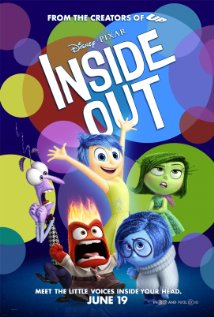
Images courtesy of Pixar and Walt Disney Pictures.
To varying degrees, we’re all creatures of emotion. When I was younger I believed I had more right than anyone else to have emotions, and, more specifically, to channel those emotions in whatever way I saw fit. After all, what did the other kids in my class know about loss? What did they know about feeling unloved or unwanted?
In my young and narrow mind, I believed they knew nothing. And as other children do, I even went so far as to believe that I was the only one in the world, that no one else had feelings, that only I could experience the world as I did. I lacked empathy, or the basic understanding of others’ emotions and the will to feel the same way.
Empathy, as with most things, came as I grew older and as I learned that others did, in fact, have the same association with loss and rejection as I did. So did the ability to understand my emotions and the reasons behind them. It was no longer enough just to feel sad or angry: I had to know why I felt the way I did, which led to understanding, which led to (hopefully) not taking those emotions out on others.
But when I was a child, with emotions so much fuller and so much more untameable, this maturity was beyond my grasp. All I knew was that I felt angry, or fearful, or happy, and I didn’t know how to keep my emotions inside where adults told me they belonged. So instead of keeping it all bottled up, I let the inside out.
Interstellar images courtesy of Paramount Pictures.
There are a lot of stories surrounding Interstellar, mostly because of director Christopher Nolan. There are stories about the technical detail Nolan displays in the film’s direction and in its science; there are stories about the film’s place in the pantheon of Nolan’s almost universally well-received movies; and there are stories about Interstellar being Nolan’s most ambitious film yet. But mostly the biggest story seems to be that Interstellar sucks. And that it got beaten at the weekend box office by a Disney movie.
If you didn’t see Interstellar this past weekend, that wouldn’t be a huge surprise. Interstellar’s opening was obviously never going to compare to Nolan’s Dark Knight trilogy $100 million plus openings (because no Batman), but even compared to Nolan’s overtly intellectual Inception, Interstellar pulled in about $15 million fewer dollars. Continue reading →
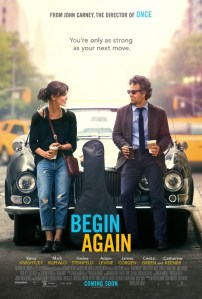
Begin Again images courtesy of The Weinstein Company
Ask any artist, any real artist, about what they do, why they do it, or who they think they are, and you’ll probably either get an intentionally pithy, almost rehearsed and ultimately empty answer or some vague construct built equally on furtive musings and deliberate concealment. More often than not, artists don’t know who they are or what they’re doing, and least of all what they want, and if they do, it’s usually more as the result of what others have said about them than any genuine self-reflection.
In general, I think it’s a falsehood for anyone seeking true self-expression to really know what’s going on, and the best most artists can ever hope for is to access and then continue finding that space where the images, notes and words just keep flowing like a force from on high, barely conscious of the material bursting forth, as they try to record, shape, and ultimately contain it all.
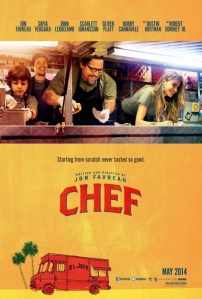
The cult of celebrity chefs may be one of the more peculiar developments of the early 21st century, but it’s a celebrity that’s at least a lot more earned than many of the other celebrities that have risen and fallen over that same time. Rather than trading explicitly in their looks, notoriety or leaked nudes, the celebrity chef must use his implicitly earned skills, often developed over years of a culinary schooling several times more difficult and demanding than your common business or dental schools (though who am I to talk, all I ever learned in school is how to write things down I hope make me seem thoughtful or clever).
However, it’s also true that the chefs for whom celebrity has come most naturally tend to be those who combine some level of photogenic intangibles and an unpredicted twist (e.g., they act crazy and wear sunglasses on the back of their head or… maybe they yell a lot), but there’s also a warmth in their tone and methods, an invitation to a world that’s not so far from our own that lets us all know that these are people often worth respecting, doing something much more worth watching.
her is one of those movies most people will go into very consciously. You won’t just be giving it a try on a “larf”, you won’t be buying your ticket, sight unseen, and you won’t be settling down into your seat not knowing what to expect. If you see it, you’ll be seeing it very deliberately. You’ll know exactly what you’re getting into. You’ll know you’ll be seeing a quirky, Oscar-nominated film and you’ll know there’ll be at least a degree of self-questioning. Perhaps the only thing you won’t know is how it could possibly end in anything other than complete and utter heartache that will leave you shattered… gutted. And in some ways, you’ll know that that’s the main reason you’re going to see it in the first place.
It’sa funny little movie. It explores the extraordinary questions of our collective, modern zeitgeist — the nature of existence, the nature of reality, the progress of technology, programming, memory and the singularity — but only on the surface. The deep thoughts that question existence itself are mere table stakes, the empty, insubstantial detritus of a film that’s aiming far higher.
The Way, Way Back opens with Duncan, our main character, being asked to rate himself on a scale of one to ten by his mom’s latest boyfriend, Trent. And if you’re a particularly sensitive person whose childhood wasn’t all that it could’ve been, that should be a polarizing moment for you. That’s the moment when you know you’re either going to be all in, for every one of this film’s emotional struggles, or you’re just going to watch a decent movie that’s occasionally funny. For me, it’s one of the greatest, most resonant and meaningful openings I’ve ever seen. There’s so much in that moment, so much pain and torment and truth, and it completely sets the tone and direction of the rest of the film.
The Way, Way Back isn’t very innovative or new; for most of us, it’s not going to be a revelation that will change the course of our lives. But for just the right viewer, that person who’s felt what Duncan is feeling and remembers what it was like back then, when you couldn’t stand what was happening, you didn’t have any control, and you had no space of your own, it’s an emotional journey that manages to be substantial but not heavy, heart warming but not cloying, truthful without being awful, and absolutely right about the things that mattered to us most.
No wonder nobody saw it.
Duncan, a shy, introverted 14-year-old, is forced to spend the summer with his mother and her new boyfriend (and his teenage daughter) at his beach house in Cape Cod. Duncan soon finds himself isolated and alone in this place filled with confident, athletic teenagers and oblivious adults enjoying their own versions of a mid-life spring break. Wanting nothing more than to spend the summer with his biological father on the West Coast, it’s not until he discovers Water Wizz, a local water park, and is taken under the wing of park manager Owen, that he finds a place for himself.
I don’t know if there’s anything about that description that would make really make anyone want to see this movie. It doesn’t sound substantially different than any other coming-of-age tale, and without produced-for-Oscar-season writing, all-star casts, a mind-bending plot, or at least one supernatural element, The Way, Way Back isn’t exactly designed to stand out. Like I said, if you watched that rate yourself sequence and didn’t feel a slight prick and then a sharp pang of anxiety, then this movie probably might not be for you. But if you did feel those things, if you felt an instant connection with Duncan as you heard him rate himself a six only for his surrogate father figure to rate him a three, then I would urge you to watch this movie.
Just looking at him, I’m sure Jim Rash had a wonderful, non-tormented childhood.
Written and directed by Nat Faxon and Jim Rash, the Oscar-winning writing team behind 2011’s The Descendants, The Way, Way Back doesn’t boast the same level of prestige or self-importance as that George Clooney vehicle, nor does it have auteur director Alexander Payne (Nebraska, Sideways, About Schmidt) to take the lion’s share of the credit. But where The Descendants is about the horrors of adulthood and the things adults do to each other, The Way, Way Back picks right up as a movie about the horrors of childhood… and the terrible things adults do to their kids. It’s also better (and less desperately emotional).
It’s hard to watch The Way, Way Back and not feel an instant connection with Duncan. He goes to the beach like he’s told, plays with kids younger than him like he’s told, and does his best to find places other than his room to hang out like he’s told. He’s awkward around everyone, especially girls his own age, and far from having any self-confidence or ability to fit in, he doesn’t even believe he can exist in this place so diametrically opposed to everything he wants or needs. As I watched him go through his days, being singled out as the only one who has to wear a life jacket, waiting to be excused from dinner tables populated by unconcerned adults (and no kids to talk to), staying out late exclusively to avoid talking to his parents, it almost felt like the producers were drawing from moments straight from my own life. Faxon and Rash display an uncommon knowledge and remembrance of places best left forgotten and times we hope we’ve grown up from even as we let them scar us much farther into our adulthoods than they should.
Along the way, however, you also start picking up on other perspectives. Duncan is our protagonist to be sure, but as you watch his mother going through the motions of what will no doubt become another failed relationship, you start to realize how hard it must be to live your life in the aftermath of failed relationships. When I was growing up, most of my friends’ parents were divorced, and, frankly, it sounded kind of great. Two houses, two living experiences, sometimes even two parents competing with each other. In the ‘90s, I think most North American concepts of marriage had moved well past the idea that divorce represented some kind of failing, and I never once got the sense that any of my friends held themselves guiltily responsible for their parents’ breakup(s). I, on the other hand, grew up with married parents that I always wanted to see get divorced, and I can tell you that this “stay together for the kids” notion doesn’t work when it’s obvious the two shouldn’t be together. But as much as I’ve hated my parents when I thought I was right, come to rely on them when I shouldn’t have needed to, learned from them even when they didn’t have a lesson to teach, and wondered aloud why they would ever continue in a relationship like theirs, I can at least appreciate where they’re coming from after watching The Way, Way Back. It’s that sense of and dedication to authenticity that makes The Way, Way Back absolutely shine.
Don’t worry if you lose touch with Susanna after this one magical summer, Duncan. I’m pretty sure her fresh face and knowing looks end up becoming this.
In terms of acting, The Way, Way Back benefits from a strong cast, including Toni Collette as Pam, Duncan’s mom, AnnaSophia Robb as Susanna, Duncan’s age-appropriate girl-next-door crush, Allison Janney’s perpetually drunk Betty, Rob Corddry’s Kip, and Amanda Peet’s overtly flirtatious Joan. Relative newcomer Liam James is utterly convincing as the type of outsider teens like to mess with and adults don’t understand. I get the feeling he actually is one of those kids and that he’s not acting at all. Steve Carell, in a complete 180 from his more familiar roles, is pitch perfect as Trent, a bully of a surrogate father who you know, deep down, is even more of an asshole than he is on the outside. Sam Rockwell, as Owen’s manager and eventual mentor, is charismatic, deeply caring, and completely understanding of what Duncan’s going through in a role that shows the actor’s ability to fully inhabit the roles he’s given. Especially given how often Iron Man 2 seems to be on TV lately, it’s jarring to see how different Rockwell can come across in a role like Justin Hammer, a sleezy, loathsome, underhanded weapons manufacturing head. It’s not as if Rockwell’s Justin Hammer delivers his lines in a markedly different manner or exhibits wildly different physical mannerisms. There’s just something about Rockwell’s portrayals that makes you want to get away from Hammer as soon as possible, even as you would spend all of your time with his Owen. Finally, Maya Rudolph, as Owen’s long-suffering assistant Caitlyn, brings depth to a character who is easy to overlook.
There’s enough character material on display in The Way, Way Back that, if this were a movie brought to us by a cruder, more Apatow-esque creative team, it wouldn’t be hard to imagine spin-off movies about Owen’s continuing need to grow up and become the man Caitlyn deserves, Trent’s need to grow out of his narcissistic tendencies to become the father his daughter needs, or Betty’s continued descent into drunken-ness in her search for a man. Even though I don’t really want to see a Faxon/Rash franchise stable of recurring characters in movies of varying validity (not that I don’t enjoy Judd Apatow’s better movies), this wellspring of fully realized characters with their own stories, motivations and needs all greatly assists in delivering The Way, Way Back’s central theme — that no matter how angry we have every right to be, we all have to take control of our own lives (even if we’re not all lucky enough to have people and places around us to help).
For a certain type of person, The Way, Way Back is deeply arresting for its message and execution, but for me it wouldn’t have meant as much to me if I had seen it in my teens, even if it’s fundamentally about being a young teenager. Its themes are universal enough that it maintains essential meaning to almost anyone of any age, but in some significant ways, it almost feels like it’s the perfect movie for someone like me, and it managed to hit me just about as hard as it could. Even at my advanced age of “somewhere over twenty-five”, when I’ve already compartmentalized most of my childhood traumas, sorted my thoughts on the universe, and now have epiphanies only occasionally, I still vividly remember (and occasionally recall) the various tragedies and triumphs of youth that would define me as a person. It’s exactly that kind of close yet distant feeling, that proximity to out formative years no matter how long ago those years may have been, that the film plays off most, and its that formation of self that it captures so well. It’s a film that reminds us that we have to take care of ourselves, because our parents, our role models, our family and friends all have their own sh*t to deal with. And even though there’s still a significant distance between my knowledge of that advice on an intellectual level and my acting that advice out in real life, I still feel like I’m a little bit better of a person for having seen The Way, Way Back.







 GOO Reviews